
From First Pitch to First Revenue: A Marketing Strategy for Tech Founders

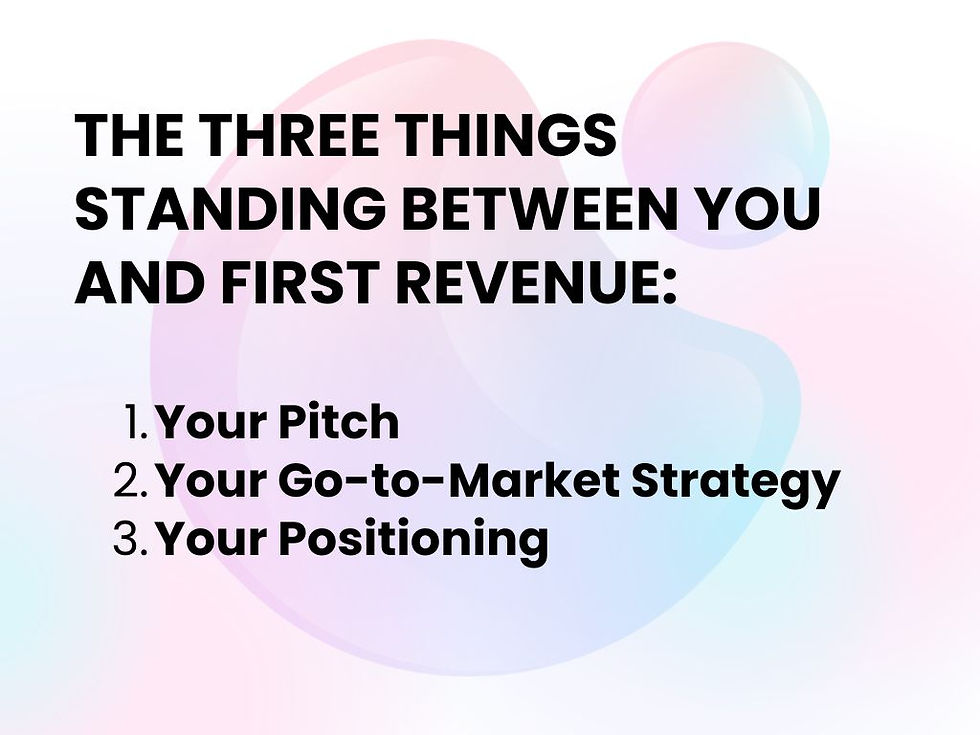
Most startups do not fail because of a bad product. They fail because of three marketing fundamentals nobody fixed early enough: a pitch that loses the room, a go-to-market strategy built on assumptions, and positioning that sounds identical to every competitor. Fix these three things and everything else in your marketing gets easier.
Your 30 Seconds Matter More Than Your Entire Deck
Investors decide in the first 10 seconds whether to keep listening. Not because they are impatient. Because clarity signals whether a founder actually understands what they are building.
A 30-second pitch is not a performance. It is a diagnostic. It exposes whether your thinking is sharp enough to survive a real conversation. After coaching founders across multiple cities and stages, the pattern is always the same: the clearest pitch wins. Not the most polished. Not the most experienced. The clearest.
Use this framework:
We help ___ who struggle with ___ by providing ___ and this matters because ___.
Four lines. If any one takes you more than a few seconds to fill in, that is your work. Write it, say it out loud, time it. Send it to contact@metrixmktg.com for direct feedback.
The Go-to-Market Sequence Most Early Founders Get Wrong
Go-to-market strategy is not something you figure out after product-market fit. It is how you find it.
The most expensive GTM mistake early founders make is trying to reach everyone. When your message is for everyone it resonates with no one. Start with one person, one problem, one context. That is your beachhead. Everything else builds from there.
Before spending anything on marketing answer these four questions:
Who has this problem urgently? Urgency drives decisions. Without it buyers wait.
Where do they already go for help? Go where your buyer already shows up. Do not build an audience from scratch.
Why would they choose you over doing nothing? Your biggest competitor is inertia, not another startup.
What does a yes look like in the next 30 days? GTM without a near-term milestone becomes theory.
Then follow this sequence:
Define one person with one problem in one context
Find where they gather online and offline
Build one offer with one outcome and one price
Start 20 direct conversations this week
Convert 3 to paid pilots
Write down exactly what made them say yes
That last step is the one most founders skip. It becomes your repeatable playbook.
Founders who skip this phase and jump straight to ads and content end up optimizing for the wrong message. Your first ten customers will teach you more than any market research report.
Go get them on purpose. Add channels after you can clearly articulate why ten customers said yes. Not before.
Why Your Startup Sounds Exactly Like Your Competitor
Open five B2B SaaS homepages right now. At least four of them use "seamless," "powerful," or "all-in-one" in the first sentence. Different products. Identical marketing.
Positioning is the foundation every other marketing decision sits on. Your messaging, channel strategy, content, and sales deck all flow from it. Get it wrong and you are not just wasting budget. You are training the market to see you as a commodity.
Positioning is not what you say about yourself. It is what your best customers say when they explain why they chose you.
This is where a technical marketing background changes the outcome. Most consultants work only from the business layer. Working from both the product layer and the buyer layer simultaneously surfaces the technical differentiation your product team understands but has never been able to articulate for a non-technical buyer. That gap is where the real positioning lives.
Run this diagnostic before your next marketing decision:
Who is your best actual customer right now? Not your target. The one who renews, refers, and never asks for a discount.
Why did they choose you over doing nothing? The real reason is usually not what you think.
What would they lose if you disappeared tomorrow? That loss is your real value proposition.
What do they call the problem you solve? Use their language, not yours.
Who is not a good fit for you? Defining the edge sharpens the center.
Good positioning is specific enough that the wrong customer immediately self-selects out. A headline built for everyone converts no one. A headline built for one specific person with one specific problem makes that person feel like you built the product for them. That feeling is worth more than any ad campaign.
If your team cannot agree on what makes you different in one sentence, that is the first thing to fix. Not the ads. Not the content calendar. Reach out at contact@metrixmktg.com to work through the positioning diagnostic together.
The Bottom Line
Pitch, go-to-market, and positioning are the same problem at three different scales. You cannot pitch clearly without clear positioning. You cannot build a GTM strategy without a defined beachhead customer. And you cannot stand out if you sound like everyone else.
Fix the foundation. Everything else follows. Not sure where to start? That's exactly where we begin: contact@metrixmktg.com
Frequently Asked Questions (FAQs)
How do I build a go-to-market strategy for my startup?
Start with one person, not a market. Define the single type of customer who has your problem urgently, find where they already gather, and build one simple offer with one clear outcome. Then have 20 direct conversations before you spend anything on marketing channels. Your first GTM strategy is a sales motion, not a marketing campaign. Channels come after you have closed ten customers and can clearly articulate why they said yes.
How do I improve my startup pitch for investors?
The most common pitch problem is not delivery. It is clarity. If you cannot explain what you do, who it is for, and why it matters in 30 seconds, no amount of slide polish will fix it. Use this framework: we help ___ who struggle with ___ by providing ___ and this matters because ___. Say it out loud, time it, and cut anything that takes you off track. Investors decide in the first 10 seconds whether to keep listening. Your opening sentence is the pitch.
What is startup positioning and why does it matter?
Positioning is the foundation every other marketing decision sits on. It determines your messaging, your channel strategy, your content, and how your sales conversations go. Bad positioning means you sound identical to your competitors, your marketing budget gets wasted amplifying a message that does not resonate, and the market starts to see you as a commodity. Good positioning is specific enough that the wrong customer self-selects out and the right customer feels like you built the product specifically for them. Fix positioning before you fix anything else in your marketing.
How do I get my first paying customers?
Skip the marketing channels and start with direct outreach. Identify the one type of person who has your problem urgently, find where they show up online or in person, and start 20 real conversations this week. Not pitches. Conversations where you listen more than you talk. Convert three of those to paid pilots, even at a small price point, and document exactly what made them say yes. That documentation becomes your go-to-market playbook. Your first ten customers will teach you more than any research report. The goal is to earn them on purpose, not wait for them to find you.


Comments